
The Technology Behind adeus: True Wills, True Notes and True Gifts
September 10, 2026
An Executor opens a document that may have been signed thirty or forty years earlier, and has to satisfy themselves, then a bank, then possibly a court, that it is the genuine Will and the last one made. If a page has been damaged, or a second copy turns up with a different date, there is often no way to settle it. That job has barely changed since 1837, while almost everything surrounding it has.
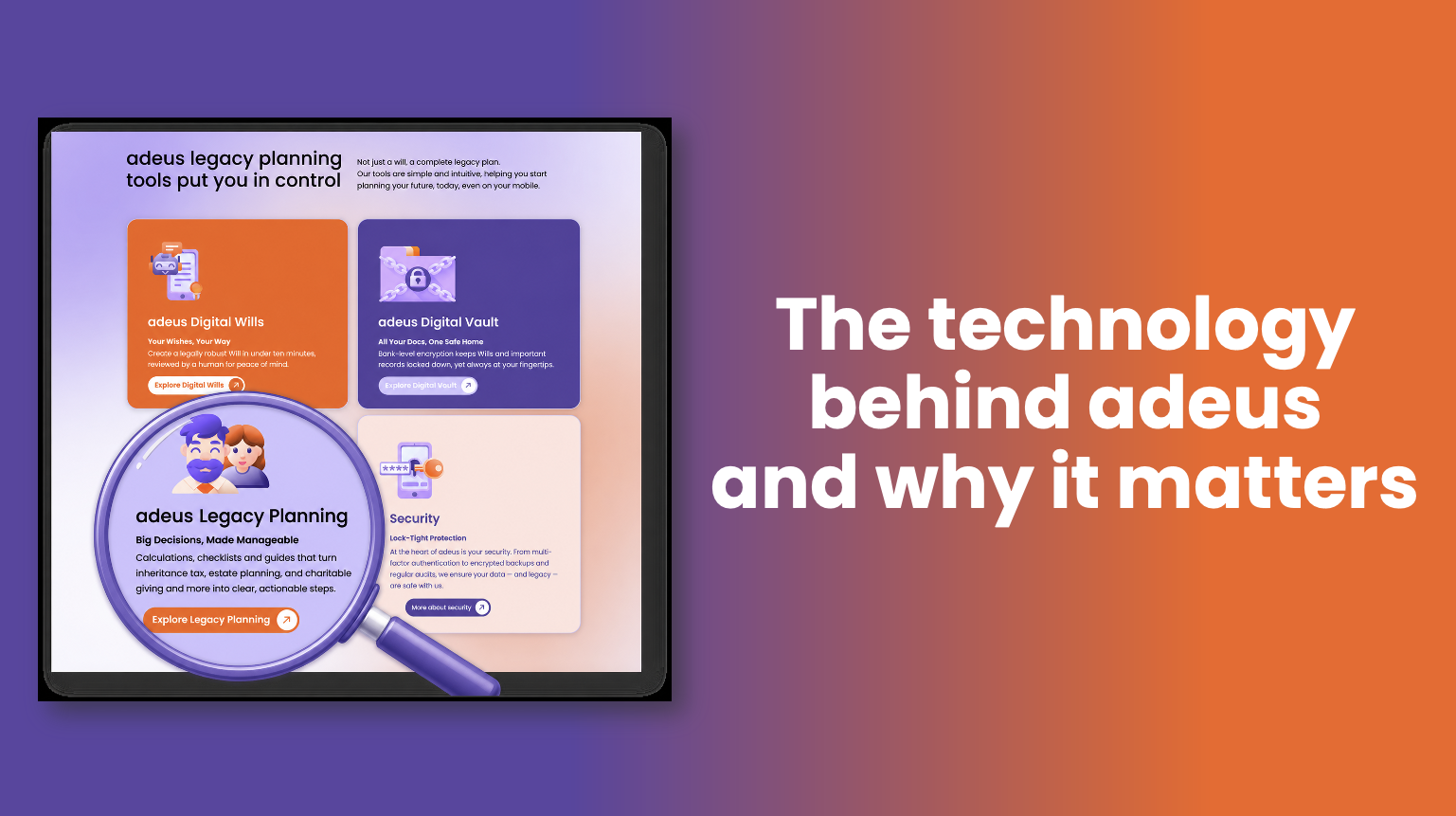
adeus is a digital Wills and legacy planning platform. People write a legal Will, build a Digital Vault of their accounts, assets and wishes, and leave items and messages to the people who matter to them. Three of those products, True Wills, True Notes and True Gifts, are built on infrastructure that most of our customers will never see and never need to think about. This is what sits underneath, and why it was built this way.
The Short Version
adeus writes a cryptographic fingerprint of a sealed document to a public, immutable, time-stamped ledger, more commonly known as a blockchain. The document itself never goes on the blockchain, and neither does any personal data. What goes 'on chain' is a SHA-256 hash, a time-stamp and a reference. That is enough to prove, years later, that a document is exactly the one that was sealed, and nothing to reveal anything about what it says or who wrote it.
Unlike the blockchain you may be familiar with, there are no wallets, no private keys, no seed phrases, no tokens and no transaction fees for the customer. They sign in with an email address and a password, as they would to any other online service. adeus handles everything else.
The Design Principle: Infrastructure, Not a Feature
Most consumer blockchain products come apart at the same point. They ask the customer to hold something they never wanted: a wallet to set up, a key that cannot be recovered if it goes missing, a fee that fluctuates, and a vocabulary to learn before anything useful happens.
The people who use adeus did not come looking for a technology product. Some are organised by temperament, already keeping their finances in order, and treat a Will as the piece missing from a system they run perfectly well. Others have been meaning to sort it out for a decade. What both have in common is that the three things standing in the way are complexity, cost and inconvenience, and normally every one of those gets worse the moment complex technology enters the process. So the technology was treated as plumbing from the first line of code. It is never sold in the interface, never named in the journey, and our own AI assistant Ady is instructed not to raise it unless somebody asks directly.
That is a product decision with an engineering bill attached. Taking the wallet away means adeus carries the key management itself, and taking the fee away means the cost of writing a record has to be small enough, and steady enough, to sit inside a consumer subscription without anyone noticing it is there. Taking the vocabulary away is the harder one, because verification still has to make sense to someone who has never heard the word hash and has no particular reason to want to.
What Is Actually Written to the Ledger
A SHA-256 hash is a fixed-length string derived from a file. The same file always produces the same string. Change one full stop, one font, one pixel of a scanned signature, and the string is entirely different. The function runs in one direction only, so a hash cannot be turned back into the document it came from, which is why the same family of functions protects banking and government data.
That one-way property is what makes the rest of the architecture possible. adeus writes the hash, a time-stamp and a record reference. The Will, the note, the file, the recipient's name, the value of an item: none of it is written. Those live in encrypted cloud storage under adeus control, with an independent backup. Anyone reading the public record learns nothing at all. Anyone holding the document can prove it matches.
The Three Products
True Wills: Proving a Will Is the Real One
Paper Wills get lost, damaged and superseded, and contested probate claims have continued to rise. The argument in a good share of those cases is not about what the Will says. It is about whether the document on the table is the genuine one and the final one.
Once a Will has been signed and witnessed, the customer scans it and uploads it. adeus fingerprints that exact document and anchors the fingerprint to the ledger. The customer receives a True Will Certificate carrying a QR code that opens the raw record. Anyone holding a copy, most usefully the Executor, can upload it and check it against that record. An identical document returns a match. An altered one does not.
What that gives the family is the end of a particular argument before it starts. The Executor knows they are administering the genuine, latest Will, and the time-stamp settles which version came last, at a moment that has enough uncertainty in it already.
True Notes: A Sealed Letter to One Named Person
A True Note is a document, file or personal message left for a single named individual. It might be a letter to a child, or instructions for one particular wish, or information that only one person has any business seeing. The customer names the recipient, writes a message, uploads the file, and the note is sealed.
True Notes are governed by a smart contract. Nothing releases automatically and nothing releases early. When the time comes, the Executor releases the note through adeus. The Executor can see who notes are addressed to, so they have a picture of the overall wishes, but never the contents. The recipient receives a secure private link and needs no adeus account to open it.
For the person writing one, the value is knowing that something private reaches one named person, in their own words, unopened by anyone else on the way, at the point they intended it to arrive.
True Gifts: Specific Items to Specific People
True Gifts records a tangible item, a watch, a ring, a painting, a collection, names who should receive it, and holds the photographs, receipts, valuations and the personal message that explains why. It also works as a private inventory with no recipient named, giving the Estate an accurate picture of what exists and what it is worth.
Each True Gift is sealed under a smart contract in the same way. The Executor confirms the item is still in the estate and accounts for it in the Inheritance Tax position before releasing it to the named recipient.
These are the bequests that rarely reach a formal Will, and they are the ones families fall out over most reliably. Recording the item, the evidence, the recipient and the reason in one place takes a whole class of disagreement off the table, and it means the small things are not overlooked or undervalued when an estate is being counted.
How a Record Is Created
The customer completes a Will, a note or a gift in adeus, in plain language, with no technical step at any point. adeus then generates a digital fingerprint of the sealed document or record and anchors it to the blockchain, funding and managing the transaction itself. In practice a True Will Certificate is ready within about fifteen minutes of upload. From then on the customer, and later the Executor, can verify any copy against that record at any time, for as long as the record exists.
Why a Public Blockchain Rather Than a Database
This is the question every technical reader asks, and the answer has nothing to do with performance. It is about what adeus is unable to do.
A paper or even a database record is exactly as trustworthy as the person or company holding it. That company can amend it, lose it, be bought, or stop existing, and a beneficiary contesting an estate is entitled to make that point. A record on a public blockchain cannot be altered by adeus, by the customer, or by anyone with something to gain from the outcome. The proof does not depend on us, and that independence is the product rather than a feature of it.
It also answers the awkward question of institutional lifespan. A Will signed this year may not be read for forty years, by which time a fair number of today's companies will not be here. The public record persists whether adeus does or not, and anyone holding a copy of the document and its certificate can still verify the two against each other.
The network was chosen against three practical criteria rather than any ideological one: a per-transaction cost low and stable enough to absorb into a consumer price with nothing charged per record, throughput sufficient to write a record for every Will, note and gift without capacity becoming a constraint, and protocol stability, so that infrastructure built today can reasonably be expected to behave the same way in thirty years.
Data Protection by Design
Public blockchain and the right to erasure are usually presented as being in tension with each other. They are not, provided the decision is made at the start rather than patched in afterwards.
No personal data is written to the ledger. A hash on its own identifies nobody, reveals nothing about its source document, and cannot be reversed. Under UK GDPR the on-chain artefact is not the personal data. The encrypted record held by adeus is, and that is where access, rectification and erasure rights are exercised in the ordinary way. Delete the underlying record and the hash becomes a string of characters pointing at nothing.
This is the single decision that makes the architecture defensible, and it is why adeus never considered writing documents, names or metadata on chain, even encrypted.
The Foundation for Electronic Wills
Every adeus Will today is printed and signed in wet ink in the physical presence of two witnesses, exactly as section 9 of the Wills Act 1837 requires in England and Wales. Nothing about the technology changes that, and adeus doesn't suggest otherwise. What the technology does is protect the signed document once it exists.
The Law Commission of England and Wales referenced the potential of distributed ledger technology for Wills in its May 2025 report on modernising the law, and its recommendations contemplate a future in which electronic Wills are permitted, subject to a reliable way of establishing authenticity, integrity and the identity of the testator. That is a records problem described in legal language, and it is the problem adeus has been solving in production while the legislation is drafted.
For investors reading this, it's worth being clear about what that does and does not mean commercially for adeus. The law change is an accelerant, not the foundation. adeus works under the law as it stands today, and the customers using it are getting the benefit now. When electronic Wills do become lawful here, the trust layer will not need building, because it is already running, and the same infrastructure could be applied today in the 16 U.S. jurisdictions that already permit what they refer to as e-wills.
What's Next?
Wills are a demanding first application, and they are one instance of a broader class. The pattern fits wherever a document has to be provably unaltered years after it was created, and trusted by somebody who was not present when it was signed and has no reason to take the custodian's word for it.
- Property deeds and title documents
- Lasting powers of attorney
- Professional qualifications and certifications
- Clinical consent
- Regulatory filings and audit records
- Chain of custody, in evidence and in high-value goods
Each has the same shape: long-lived documents, a verifying party at a distance, and a custodian whose own assurance is not enough on its own. The transferable lesson from building it for consumers first is the one least often applied. Adoption followed from hiding the technology, not from explaining it.
Frequently Asked Questions
What is written to the blockchain by adeus?
A SHA-256 cryptographic hash of the sealed document, a time-stamp and a record reference. Never the Will, the note, the file, or any name or personal data. The document itself is held in encrypted cloud storage with an independent backup.
Do adeus customers need a crypto wallet or a private key?
No. adeus holds and manages everything required to write to the ledger. There is no wallet to create, no key to lose, no token to buy and no transaction fee. The customer signs in with an email address and a password.
How does verification of an adeus True Will work?
The holder of a copy, usually the Executor, uploads it through the True Will Certificate. adeus hashes the uploaded file and compares it with the anchored record. An identical document returns a match. Any alteration, down to a single full stop, returns no match and is flagged for investigation.
Is a blockchain-anchored Will legally valid in England and Wales?
The Will is valid because it was printed and signed in wet ink before two witnesses under section 9 of the Wills Act 1837. The anchored record does not create validity. It evidences that a specific signed document has not been altered since the moment it was sealed.
How does adeus reconcile public blockchain with UK GDPR?
By keeping personal data off chain entirely. Only an irreversible hash, a time-stamp and a reference are published, none of which identify anyone. All personal data sits in encrypted storage controlled by adeus, where data subject rights including erasure are exercised normally.
What happens to the record if adeus ceases to exist?
The record persists on the public ledger independently of adeus. Anyone holding a copy of the document and its certificate can still verify the two against each other. That durability is a substantial part of why a public network was chosen over a private ledger.
Are True Wills, True Notes and True Gifts live products?
Yes. All three are in production and in day-to-day use by paying customers planning real estates. None of them is a pilot or a proof of concept.
The Point of All of It
Most people write a Will once and never look at it again, and the estates now beginning to pass between generations are the largest there have ever been. In the UK alone, an estimated £5.5 trillion will pass through inheritance in the next three decades. Both of those facts point at the same requirement, which is records that hold their integrity across decades without anybody tending them.
That is the thinking behind all of the above. Not a better version of the will-writing service people have had for two centuries, but a category rebuilt around what a legacy plan now has to survive: time, distance, a family that may disagree, and institutions that come and go. The infrastructure is what makes that possible. The interface - user friendly and mobile first - is why anyone bothers with it.
For media enquiries, partnership discussions or investor conversations, contact Mark Hedley, Co-Founder and COO, adeus, at hello@adeus.life.


