
Electronic Wills UK: Missed Deadline (September 2026 Update)
September 23, 2026
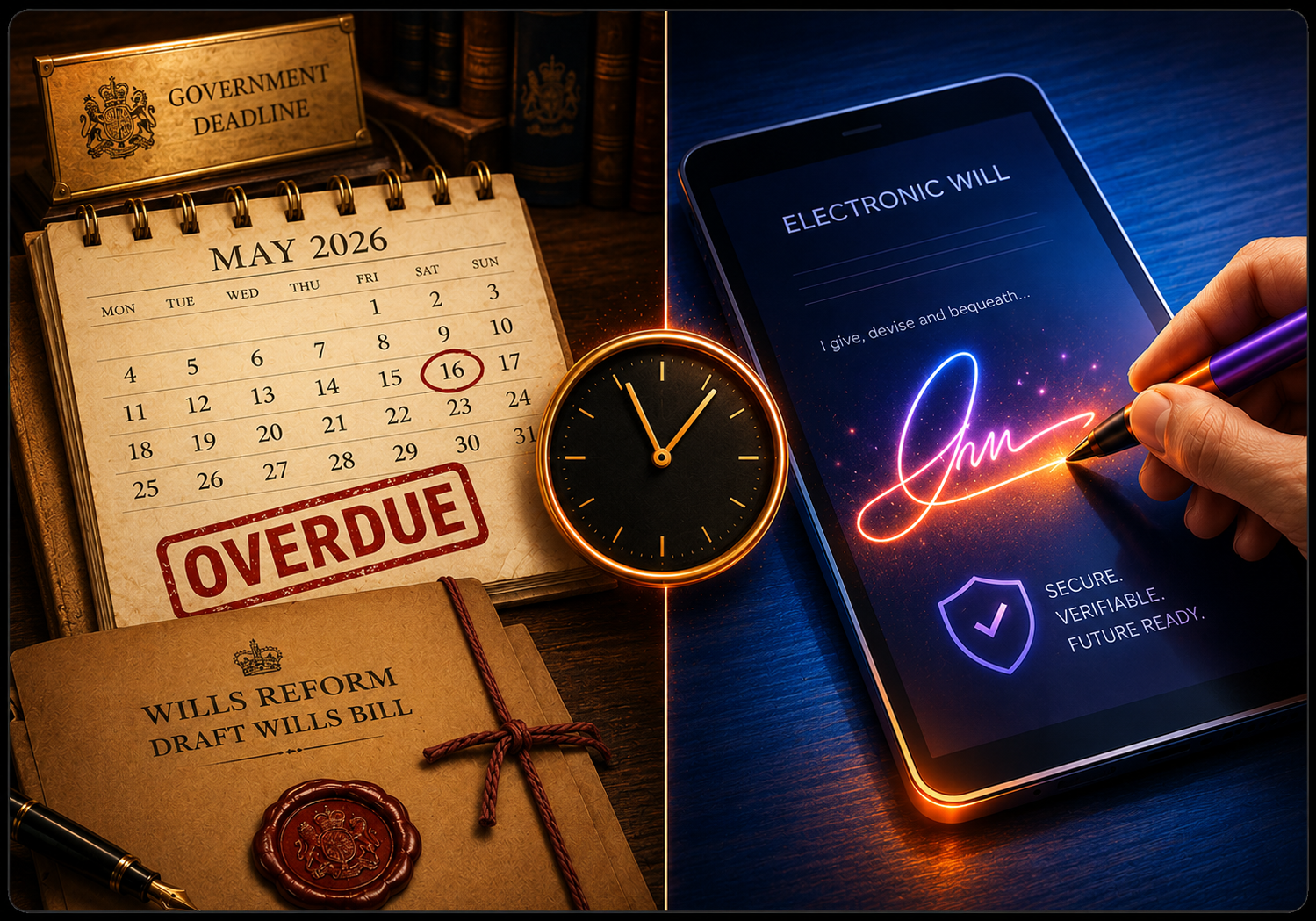
Electronic Wills UK: Government Misses Reform Deadline
In our earlier guide, Electronic Wills UK: Are They Legal?, we explained that the government was due to publish its detailed response to the Law Commission’s landmark wills reform report by 16 May 2026. That date has now passed. As of late September 2026, no detailed response and no timeline for legislation have been published.
This update explains what the missed deadline means, recaps the essentials for anyone reading about electronic wills for the first time, and sets out why adeus is ready to move the moment the law does.
The Quick Answer
Electronic wills are still not legally valid in England and Wales. They require new primary legislation. The Law Commission published its final report, Modernising Wills Law, and a complete draft Wills Bill on 16 May 2025. Under the formal Protocol between the government and the Law Commission, ministers were required to give a full response within one year, by 16 May 2026. That deadline has been missed. The reform is not dead, but it has stalled at the very first procedural step.
What the Missed Deadline Actually Means
When the Law Commission publishes a report, there is an agreed framework for how government should respond. The Protocol between the Lord Chancellor and the Law Commission sets out two commitments on timing. The government should provide an interim response “as soon as possible and in any event within six months”, and a full response “as soon as possible after delivery of the interim response and in any event within one year of publication of the report”.
For the wills report, that means an interim response was due by around 16 November 2025 and a full response by 16 May 2026. The only document on record is a one-page holding statement published on 16 May 2025, the day the report landed, welcoming it and promising “detailed consideration”. As of late September 2026, that single page is still the government’s entire published position.
The delay has not gone unnoticed. In November 2025, six months on from the report, the Law Society publicly criticised the lack of progress, warning in its statement No will to act on wills reform that the government “risks denying people access to justice and the right to protect their last wishes”. The full response remains outstanding.
An open letter signed by industry leaders including the adeus founders Mark Hedley and Nick Adams and politicians has called on the government to speed up progress on making digital wills legally valid. Seven cross-party MPs, including Wera Hobhouse MP, Matt Bishop MP and Ayoub Khan MP have signed the letter.
Reform of this magnitude deserves careful consideration, and the government is right to weigh it properly. But the groundwork has already been done. The Law Commission spent many years on this review, including extensive public consultation, and the key stakeholders are in agreement that reform is needed. The minister responsible, Courts and Legal Services Minister Sarah Sackman KC MP, has said on the record that “the current law is outdated, and we must embrace change”. With that level of consensus and the backing of industry experts, this should be a straightforward win for the government.
It is also a win with real societal impact. Modernising how wills are made would reduce many of the causes of contested wills, the disputes over validity, lost documents, and uncertain signatures, that drive delays in probate and pile further pressure on an already overstretched court system. Every month without a response pushes a Wills Bill, parliamentary scrutiny, Royal Assent, and commencement further down the road.
Meanwhile, Other Countries Are Moving Ahead
While England and Wales wait, other jurisdictions are pressing ahead. In the United States, a growing number of states have enacted electronic wills legislation. New York became one of the latest, signing its Electronic Wills Act into law in December 2025, with the new rules due to take effect in June 2027. More than a dozen US states now permit electronic wills in some form. The international direction of travel is clear; the open question is whether England and Wales keep pace.
A Recap for First-Time Readers
If this is your first time reading about the reform, here is what you need to know.
An electronic will is a will that is created, signed, witnessed, and stored digitally, without paper or wet-ink signatures. It does exactly what a paper will does, but without the paper. Electronic wills are not currently legal in England and Wales. Creating a valid will here still relies on the Wills Act 1837, which requires a handwritten signature on a printed document with two witnesses physically present.
Modern consumers expect digital solutions. We live our lives online: banking, investments, mortgages, tax, and almost every other important task is now handled through an app or a website. Against that backdrop, it is remarkable that in 2026 making a will still depends on antiquated paper and the physical presence of witnesses, when the technology to do it securely online is already part of our daily lives.
That friction is one reason more than half of UK adults do not have a valid will. When someone dies without one, their estate is divided under the Rules of Intestacy, a rigid formula that, for example, leaves an unmarried partner with nothing, however long the couple lived together.
On 16 May 2025, the Law Commission published Modernising Wills Law alongside a draft Bill to replace the 1837 Act. Its headline recommendations include allowing electronic wills, permitting remote witnessing by live video, lowering the minimum age to make a will from 18 to 16, abolishing the rule that automatically revokes a will on marriage, and adopting a modern test of mental capacity based on the Mental Capacity Act 2005.
The “Reliable System”: The Key Concept
The Law Commission draft bill did not tie electronic wills to any single technology. Instead it requires that they be created and stored on a “reliable system”, defined by what it must achieve rather than how. A reliable system must link the testator and witnesses to their signatures at the time of signing, allow the authentic will to be identified from copies, and protect it from unauthorised alteration or destruction.
At adeus, we translate those legal requirements into three plain-English foundations: Authenticity (proving who signed), Security (protecting the signing environment from fraud and coercion), and Integrity (ensuring the will cannot be altered after it is signed). We explain the full framework in our guide, What is a ‘Reliable System’ under the Law Commission’s Draft Wills Bill?.
Why the Delay Does Not Change What You Should Do
A stalled government timeline does not change the most important fact: the only will that protects your family is a valid one made today. Reform will not help anyone who dies before it takes effect, and the coming changes will not invalidate existing wills.
If you do not yet have a will, making one now is the single most valuable step you can take. If you already have one, it is worth checking how securely it is stored. Paper wills can be lost, damaged, or disputed after death with no way to prove they are genuine, and in an age of AI and deepfakes, that risk is rising.
adeus Is Built and Ready
While the government deliberates, we have kept building. The infrastructure for electronic wills, the “reliable system” the Law Commission describes, is now built. adeus is not waiting to start development when the law changes; we are positioned to go live the moment legislation permits it.
In February 2026 we launched adeus True Wills™, which brings the core protections of the electronic wills framework to paper wills today. When you create your will with adeus, we generate a unique cryptographic fingerprint of the document, time-stamp it immutably, store it separately from the will itself, and version-lock it so there is never any doubt about which version is current. Any change to the document, even a single character, is immediately detectable. Your executor gains access only after identity verification and a certified death certificate, and receives a court-ready adeus True Will Certificate proving the will’s authenticity and provenance.
Supported by a £500,000 Innovate UK Smart Grant and backed by LawtechUK, adeus is recognised as an emerging leader in this space. The same platform that helps your write and protect your paper will today is engineered to support fully electronic creation, signing, and storage the instant the regulatory framework is in place. When the law catches up, you won’t need to start again.
Frequently Asked Questions
Are electronic wills legal in England and Wales yet?
No. They require primary legislation that has not yet been introduced.
Did the government miss its deadline?
Yes. Under the Protocol between the government and the Law Commission, a full response to the May 2025 report was due by 16 May 2026. As of late September 2026, only a one-page holding statement from May 2025 has been published.
Does the delay mean reform has been cancelled?
No. There is no legal penalty for a missed Protocol deadline, and the government has stated it accepts the current law is outdated. The reform has stalled, not stopped.
When will electronic wills become law?
There is no confirmed timeline. The next milestone is the government’s full response, which is now overdue. Legislation would then need to pass through Parliament before electronic wills become valid.
Are electronic wills legal anywhere else?
Yes. More than a dozen US states have enacted electronic wills legislation. New York signed its Electronic Wills Act into law in December 2025, due to take effect in June 2027. England and Wales would be following a well-established international direction of travel.
What should I do now?
Make or update your will and ensure it is securely stored and verifiably protected. A will made correctly today is fully valid and unaffected by future reform.
What to Watch For Next
The single most important near-term milestone is still the government’s full response to the Law Commission’s report, now overdue. When it arrives, it should confirm which recommendations ministers accept, whether the Law Commission’s draft Bill will form the basis of legislation, and an indicative timeline for a Wills Bill. We will publish an update as soon as it is released.
Follow adeus on LinkedIn and follow Mark Hedley to stay informed as the reform progresses.
For press enquiries, please contact us at hello@adeus.life
This article is for informational purposes only and does not constitute legal advice. If you need advice about your specific circumstances, please consult a qualified solicitor. Last updated 23 September 2026.


